

When building a new business website, one of the first decisions is choosing how the website should be developed.
Businesses can use a pre-designed website template or invest in professional web development. Both approaches can work, but they serve different business needs.
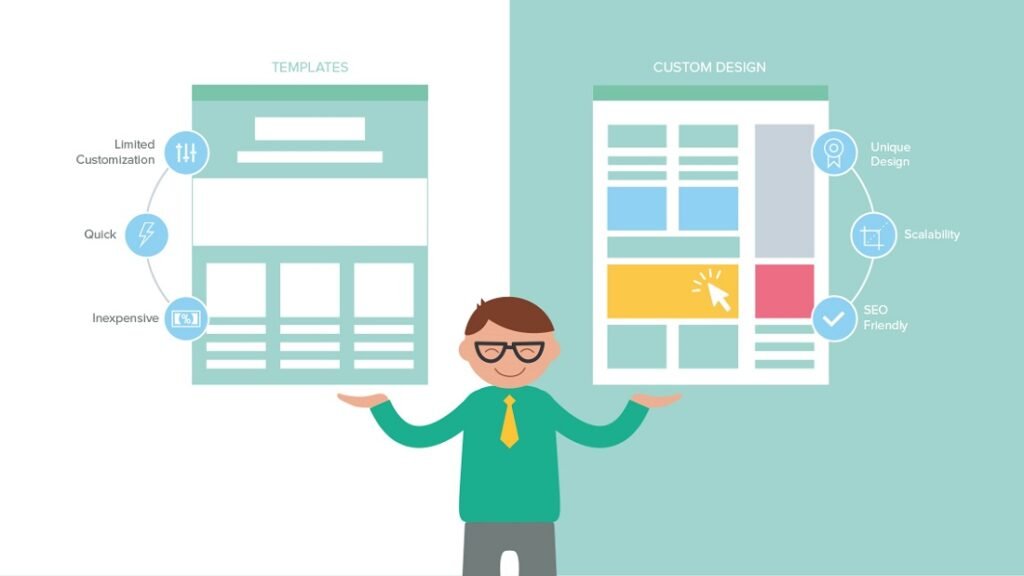
Templates can help businesses launch quickly with a lower initial investment, while custom development provides greater flexibility, control, scalability, and opportunities to build a website around specific business goals.
In 2026, there is another factor businesses should consider: AI readiness.
Modern websites increasingly need to support AI-powered search, intelligent customer experiences, automation, personalization, and data-driven features. This makes the development approach more important for businesses planning long-term online growth.
The right choice depends on your budget, functionality, growth plans, customer experience, SEO requirements, and future technology needs.
What Is a Website Template?
A website template is a pre-designed layout that provides the basic structure and visual appearance of a website.
Templates are commonly available for platforms such as WordPress and other content management systems.
Businesses can usually customize elements such as:
- Colors
- Fonts
- Images
- Logos
- Text
- Menus
- Basic page layouts
Templates can be useful for businesses that need a relatively simple website and want to get online quickly.
However, businesses should also consider whether the template can support their future requirements.
What Is Custom Web Development?
Custom web development involves creating website functionality and layouts specifically for a particular business.
Instead of starting with a fixed design, developers can build the website around the company’s branding, customer journey, technical requirements, SEO strategy, and long-term goals.
Custom development can include:
- Unique page layouts
- Custom functionality
- Advanced integrations
- Custom forms
- Booking systems
- Customer portals
- E-commerce features
- API integrations
- Advanced search
- Business-specific tools
- AI-powered functionality
This approach gives businesses greater control over how the website works, evolves, and integrates with other digital systems.
Businesses looking for custom web development services USA can create a website around their actual business processes rather than limiting functionality to what a template provides.
Templates Are Faster to Launch
One of the biggest advantages of templates is speed.
A pre-designed template already provides much of the basic layout and styling. Developers can customize it with the company’s branding and content, allowing the website to launch relatively quickly.
This can be useful for:
- Startups
- Small businesses
- New projects
- Businesses with simple requirements
A template may be sufficient when the main goal is to establish a basic online presence.
However, faster development does not necessarily mean the template will remain suitable as the business grows.
Custom Development Provides More Flexibility
A major advantage of custom development is flexibility.
With a custom website, developers can create features based on the specific requirements of the business instead of trying to adapt the business to an existing template.
For example, a company may need:
- A custom quote calculator
- Advanced booking functionality
- A customer dashboard
- A unique registration process
- A CRM integration
- An AI-powered assistant
Custom development can accommodate these requirements more effectively.
AI Readiness Is Becoming More Important
AI is changing how people discover information and interact with businesses online.
Customers may use AI-powered search tools to ask questions, compare businesses, find services, and research products.
Businesses should therefore consider whether their websites can support modern search and digital experiences.
An AI-ready website should have:
- Well-structured content
- Clear information architecture
- Strong technical SEO
- Fast performance
- Accessible content
- Structured data where appropriate
- Clear business information
- Useful and authoritative content
A custom development approach can provide more control when a business wants to integrate advanced AI features into its website.
AI Features Can Go Beyond Chatbots
When businesses think about AI websites, they often think only about chatbots.
However, AI can be used in many different ways.
Depending on the business, AI may support:
- Intelligent website search
- Product recommendations
- Content personalization
- Lead qualification
- Customer support
- Automated workflows
- Data analysis
- Conversational interfaces
These features may require integrations with external platforms or custom functionality.
A template can sometimes support basic AI integrations through plugins, but more complex requirements may benefit from custom development.
Which Option Offers Better Design Control?
Templates provide a starting point for design, but they often have predefined structures.
Even when a template offers customization options, businesses may encounter limitations involving layouts, sections, navigation, and functionality.
Custom development provides significantly greater design freedom.
Developers can create:
- Unique layouts
- Custom navigation
- Branded interactions
- Specialized landing pages
- Unique animations
- Custom conversion flows
- Personalized customer journeys
This can be particularly valuable for businesses that want their website to have a distinctive identity.
SEO Considerations
Both template-based and custom websites can perform well in search engines.
The development approach alone does not guarantee SEO success.
Important factors include:
- Website structure
- Content quality
- Page speed
- Mobile usability
- Internal linking
- Metadata
- Crawlability
- Technical implementation
- Search intent
A poorly optimized custom website can perform worse than a well-optimized template website.
For businesses focused on organic growth, SEO should be considered during the planning and development process.
SEO for AI Search
Traditional search is also evolving toward more conversational and AI-powered experiences.
Businesses should create content that answers genuine customer questions clearly and comprehensively.
For example, instead of creating a page around only one short keyword, a business can explain:
- What the service is
- Who needs it
- How it works
- What benefits it provides
- What customers should consider
- Frequently asked questions
Clear content structure can help both users and modern search systems understand the website.
The goal should be to provide useful information rather than simply inserting keywords throughout the page.
Website Speed and Performance
Website performance can vary significantly depending on how a website is built.
Some templates include features, scripts, animations, and plugins that a particular business may not actually need.
Unnecessary functionality can increase page size and affect loading performance.
Custom development can allow developers to build only the functionality required by the business.
However, custom code is not automatically faster. Poor development practices can also create performance problems.
The quality of implementation matters more than simply choosing one development approach.
Security and Maintenance
Security is another important consideration.
Template-based websites often rely on themes and plugins that need regular updates. Businesses need to monitor compatibility and security issues as their website evolves.
Custom websites may provide greater control over the codebase, but they also require professional maintenance.
Regardless of the development approach, businesses should maintain:
- Secure hosting
- Regular backups
- Software updates
- Strong authentication
- Security monitoring
- Proper user permissions
Website security should be treated as an ongoing responsibility.
Which Option Is More Scalable?
Scalability is particularly important for businesses expecting to grow.
A basic template may be perfectly suitable when a company has a small number of pages and simple requirements.
Problems can appear when the business starts adding more complex functionality.
For example, the company may eventually require:
- Advanced ecommerce
- Customer accounts
- Custom integrations
- Automated workflows
- Multiple locations
- Complex filtering
- Custom reporting
- AI-powered features
Custom development can make it easier to build around these requirements from the beginning.
Templates Can Still Be the Right Choice
Custom development is not always necessary.
A template can be an excellent solution when the business needs:
- A simple company website
- Basic service pages
- A blog
- Contact forms
- Standard layouts
- A limited initial budget
- A fast launch
For these requirements, a professionally configured template may provide excellent value.
The key is choosing a quality template and avoiding unnecessary customization that makes the website difficult to maintain.
Custom Development Can Be Better for Unique Businesses
Businesses with specialized requirements may benefit more from custom development.
For example, custom development can make sense for:
- SaaS companies
- Large ecommerce businesses
- Marketplaces
- Membership platforms
- Financial platforms
- Healthcare systems
- B2B portals
- Businesses with custom internal workflows
When the website is an important part of the company’s operations, flexibility can become more valuable than simply minimizing initial development costs.
Consider the Total Cost
One common mistake is comparing only the initial development price.
A cheaper template website may require significant customization later if the business outgrows its original structure.
At the same time, a custom website can have higher initial development costs and require specialized support.
Businesses should consider the total cost of ownership, including:
- Development
- Hosting
- Maintenance
- Security
- Updates
- New features
- Integrations
- Performance optimization
Looking at long-term requirements can help businesses make a more informed decision.
Think About User Experience
The website should ultimately be designed around the customer.
A business should consider how easily visitors can:
- Find information
- Understand services
- Compare options
- Contact the company
- Complete purchases
- Book appointments
- Navigate between pages
AI can also improve the user journey by helping visitors find relevant information more quickly.
However, AI features should make the experience easier rather than adding unnecessary complexity.
What Should Small Businesses Choose?
For many small businesses, the answer depends on their current requirements and growth plans.
A template-based website may be sufficient if the company needs a professional online presence with standard functionality.
Custom development becomes more attractive when the business needs unique features, advanced integrations, specialized user experiences, AI functionality, or a website that will play a major role in business operations.
The goal should not be to choose the most technically advanced option.
It should be to choose the option that provides the right balance of functionality, cost, performance, flexibility, AI readiness, and scalability.
How to Make the Decision
Before choosing between a template and custom development, ask:
- How complex is the website?
- Do we need unique functionality?
- Will the website need advanced integrations?
- Do we need AI-powered features?
- How quickly does the website need to launch?
- What is the available development budget?
- How much customization will be required?
- What are our long-term growth plans?
- How important is the website to daily business operations?
- Who will maintain the website?
- Will the current solution support future SEO and AI-search requirements?
The answers can make the decision much clearer.
Final Thoughts
There is no universal answer to custom web development versus templates.
Templates can provide speed, affordability, and convenience for businesses with straightforward requirements. Custom development provides greater control and flexibility for companies with specialized needs or ambitious growth plans.
In 2026, businesses should also consider how their websites will support AI search, automation, personalization, and emerging digital experiences.
Whether you choose a template or custom development, the website should ultimately be fast, secure, mobile-friendly, easy to use, SEO-friendly, AI-ready where appropriate, and designed to support measurable business objectives.
The best development approach is the one that fits your business today while giving you a practical path to grow tomorrow.